


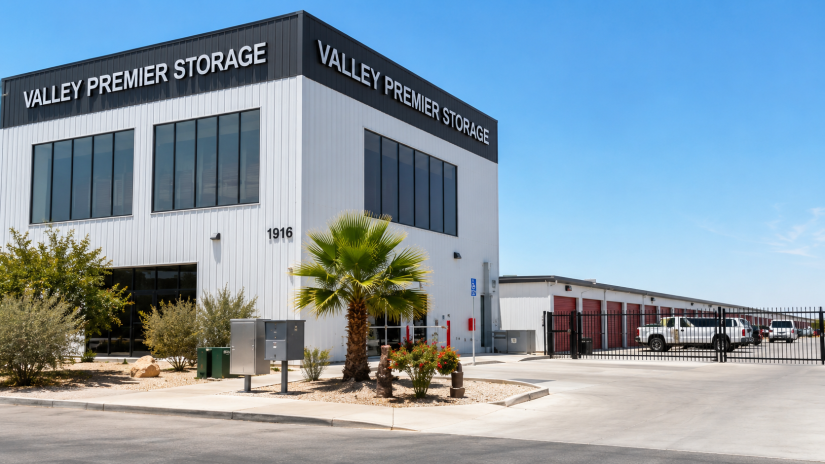


Climate Controlled Storage in El Centro Heat: What It Actually Changes
El Centro sits in the Imperial Valley as a hot desert climate with over 350 days of sunshine a year, and its summers are not the kind of heat that breaks at night. Daytime highs regularly climb past 100 degrees from June through September, but the numbers that matter more for anything sitting in a closed space are the overnight lows, which typically stay in the high 70s. A standard, uninsulated storage unit in that pattern does not get a real cooling period. It heats during the day and starts the next day already warm.
The record high on file for the area is 122 degrees, and July and August average highs run in the 114 to 115 degree range. That is a specific kind of heat load, sustained across months rather than a handful of extreme days, and it is worth understanding concretely before deciding whether a standard unit or a climate controlled one makes sense for what you are storing at Valley Premier Storage in El Centro.
Why Nighttime Temperatures Matter More Than the Daytime Number
A single 100 degree afternoon is not what damages most stored items. Repeated heat cycling, where a space heats up during the day and never fully cools overnight before heating again the next day, is what stresses materials over weeks and months. In a region where nighttime lows sit in the high 70s for most of the summer, a standard metal storage unit can spend a large share of the season sitting well above outdoor ambient temperature during the day and still warm at night, since there is no meaningful cool down period to reset from.
This is the specific reason El Centro's climate is worth treating differently than a market with a wider day to night temperature swing or a shorter hot season. A facility in a region that cools into the 50s overnight gives stored items a daily recovery period even during a hot stretch. El Centro's summer largely does not offer that.
What Climate Controlled Storage Moderates, and What It Does Not
Climate controlled storage generally keeps a unit within a narrower temperature range than an uninsulated space exposed to full outdoor swings, which reduces the extremes an item experiences and can help with materials sensitive to heat cycling and humidity swings. It is not a guarantee against all forms of damage, and it does not substitute for how an item was packed, its condition before storage, or how long it sits without being checked.
Two customers reviewing Valley Premier Storage specifically called out the air conditioning as a reason they chose the facility, one noting it made the space workable for longer work sessions in the heat and another recommending it directly for anyone needing an office or storage space with air conditioning. That kind of firsthand account from people actually using the space during an Imperial Valley summer is a more grounded signal than a general claim about what climate control accomplishes anywhere.
Items Where Sustained Heat Specifically Matters
Not every category of stored item responds to heat the same way, and El Centro's particular heat pattern makes some distinctions more relevant here than they would be in a milder climate.
Wood Furniture and Instruments
Wood expands and contracts with temperature and humidity changes. In a climate with wide daily swings and no real overnight cooling, that expansion and contraction repeats every day for months rather than occasionally. Veneer separation, joint loosening, and warping are the practical outcomes over a long enough storage period in an uncontrolled space.
Electronics and Media
Heat accelerates the breakdown of certain plastics, adhesives, and battery components. A laptop, a game console, or old media stored in a unit that regularly sits above 100 degrees for months is a different situation than the same items stored somewhere that only occasionally sees that temperature.
Documents, Photos, and Paper Records
Paper and photographic materials degrade faster under sustained heat, particularly when heat is paired with any humidity, which does occasionally spike in the Imperial Valley when Gulf of California moisture surges push through in late summer. For a small business storing tax records, contracts, or client files, this is less about the number of degrees the standard unit reaches during storage and more about the fact that the exposure is not a one time event but a repeated cycle across an entire summer.
Items Less Affected by This Specific Climate
Plastic totes, most metal tools, and non electronic hardware tolerate heat cycling far better than the categories above. A business storing durable equipment or a household storing seasonal decorations in sealed plastic containers does not necessarily need to weigh climate control the same way as someone storing wood furniture or paper records.
Deciding Between a Standard and Climate Controlled Unit at This Facility
The decision comes down less to a general rule and more to what is actually going into the unit and for how long. Climate controlled storage is available at Valley Premier Storage alongside standard drive up units, and the right choice depends on specifics rather than defaulting to one option automatically.
Storage Duration Changes the Calculation
A unit needed for a few weeks during a move carries less cumulative heat exposure risk than one holding the same items for a full summer or longer. Someone storing furniture for a short gap between homes is in a meaningfully different position than someone using long term storage for the same furniture across multiple Imperial Valley summers.
What a Small Business Is Actually Storing
Commercial storage customers in El Centro often have a mix of item types in one unit: paper files, equipment, seasonal inventory, and sometimes electronics. Rather than treating the whole unit as one decision, it can be worth separating what genuinely needs climate control (records, electronics) from what does not (durable equipment, sealed containers), which sometimes changes whether a full climate controlled unit or a smaller one makes sense.
What Insurance Does and Does Not Cover for Heat Related Damage
Most renter's insurance and facility storage insurance policies are written around specific perils such as fire, water damage, or theft. Gradual heat related deterioration, the kind that shows up as warped wood or a discolored photograph after months in a hot unit, is a harder claim to make under most standard policies, since it reads as a condition that developed over time rather than a single covered event. This is worth checking directly with whatever policy applies to your unit rather than assuming heat damage falls under general storage coverage, since the answer varies by carrier and by how the damage is documented.
For anyone storing items with real replacement value, cost, or sentimental weight, taking dated photos of an item's condition before it goes into storage is a simple step that at least creates a record, even if it does not resolve the coverage question on its own.
First Time Renters Versus Someone Storing Through Multiple Summers
Someone renting a unit in El Centro for the first time, often during a move or a short term need, is usually thinking about the decision as a single season at most. The heat cycling problem described above is real even for a single summer, but it is a different calculation than the one facing a renter who has already been through a summer or two in a standard unit and is deciding whether to switch.
A first time renter without a strong sense of how their specific items respond to heat has less to go on, which is one reason it is worth separating item categories explicitly rather than making one blanket call for the whole unit. Someone who has already stored through a summer and noticed a problem, whether that is a musty smell, warped furniture, or degraded documents, has direct evidence the first time renter does not, and that experience is a more reliable guide for the next decision than a general recommendation would be.
What This Looks Like Over a Full Imperial Valley Season
Most of the reasoning above holds for a single hot month. It compounds over a full June through September stretch in a way that a one month rental does not fully capture. Someone storing items from early summer through fall in a standard unit is not experiencing one hot week repeated. They are experiencing roughly four months of daily heat cycling with limited overnight relief, which is a meaningfully longer exposure window than the same decision would represent in a region with a shorter or milder summer.
If you are weighing a unit at Valley Premier Storage for the season rather than a short term need, that duration is the detail most worth factoring in before choosing between a standard and climate controlled space, more than the temperature number on any single day.
The team at Valley Premier Storage in El Centro can walk through which unit type fits what you are actually storing, particularly for anyone unsure whether their specific items warrant climate control or would hold up fine in a standard unit through an Imperial Valley summer.


