




Garage Cleanout in Southern California: What to Keep, What to Toss, What to Store
Southern California garages have a specific problem. The weather never forces the issue. In places with harsh winters, people clean out their garages because they have to, frozen pipes, snow equipment, seasonal urgency. In San Diego, the Inland Empire, East County, and surrounding areas, the garage just quietly fills up over years because there's never a compelling reason to deal with it. Until you want to park a car in there again, or sell the house, or just stop opening the door and feeling defeated.
A garage cleanout in SoCal isn't complicated, but it does require a system. Here's one that works.
Why Southern California Garages Fill Up Differently
The mild climate means outdoor gear doesn't rotate the way it does in other parts of the country. In a cold climate, summer gear comes out in June and goes back in September. In Southern California, the surfboard, the camping chairs, the hiking poles, and the beach umbrella are theoretically accessible year-round, so they never get properly stored. They just get leaned against whatever was already there.
Add to that the fact that Southern California homes, particularly in older neighborhoods in El Cajon, Lakeside, Chula Vista, and San Marcos, were often built with smaller garages than the amount of stuff modern families accumulate. A two-car garage that actually fits two cars is increasingly rare. Most of them fit one car and a decade of decisions that got deferred.
The other factor is outdoor living. SoCal culture means more patio furniture, more grills, more pool and lawn equipment, more gear for activities that people in other climates don't do year-round. All of that ends up in the garage when it's not being used, which is most of the time.
Step One: Pull Everything Out
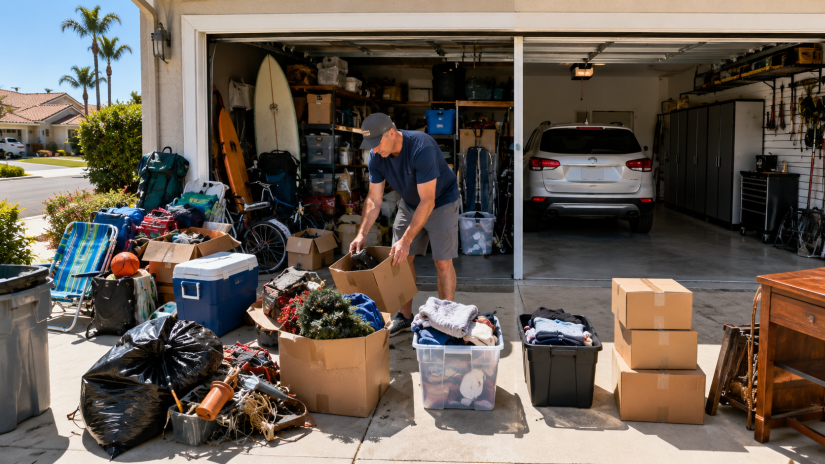
The most important part of a garage cleanout is also the most annoying one. Everything has to come out before anything can be properly sorted. Trying to organize a garage by moving things from one corner to another just rearranges the problem.
Pick a weekend with mild weather. Spring or fall mornings in SoCal are ideal for this. Pull everything into the driveway. Group things roughly as you go, tools together, sports gear together, boxes together, furniture together. You don't need to be precise at this stage, just get it all visible.
Once the garage is empty, sweep it out and take a look at what you're actually working with. How much space is there? Where are the outlets? Is there a water heater or HVAC unit taking up floor space? Knowing the real dimensions before you start putting things back changes what's possible.
The Four-Category System
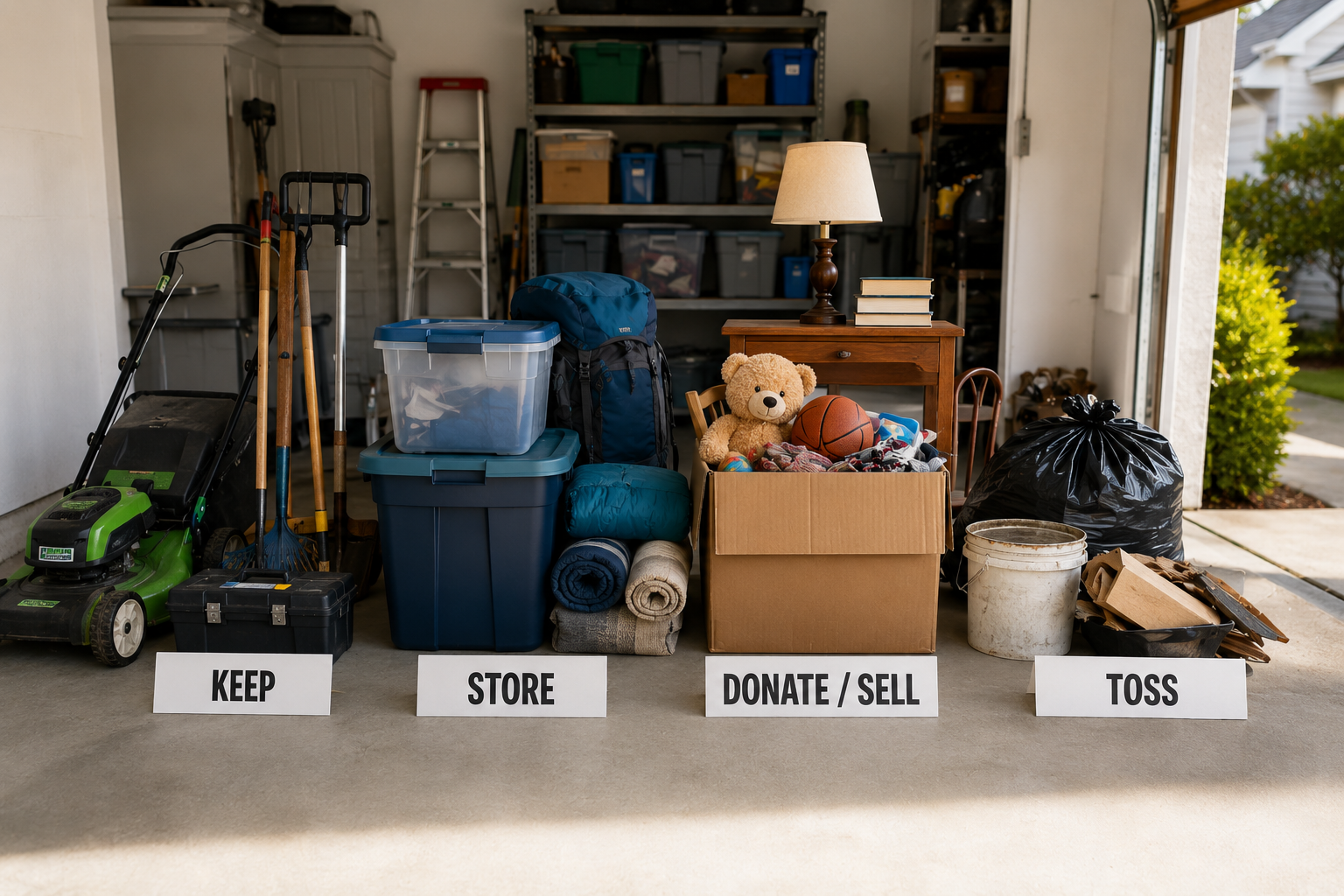
Everything on the driveway goes into one of four categories:
- Keep in the garage
- Store offsite
- Donate or sell
- Toss
The decisions get easier once you commit to the categories rather than evaluating each item individually without a framework.
Keep in the Garage
Keep in the garage is for things you use regularly and need accessible. Tools you reach for monthly. The lawnmower. The car cleaning supplies. The bikes if the family actually rides them. The camping gear if you camp several times a year. If something hasn't been touched in over a year, it doesn't belong in this pile.
Store Offsite
Store offsite is for things worth keeping but not worth taking up garage space. Seasonal decorations you use once a year. Furniture from a previous home you're not ready to part with. Sports equipment for activities you still do but not frequently enough to justify prime garage real estate. Family items with sentimental value. A storage unit handles all of this without the guilt of getting rid of it or the cost of a larger home.
Donate or Sell
Donate or sell is for things in good condition that someone else could use. Furniture, appliances, tools, sporting goods, kids' gear they've outgrown, all of this moves well on Facebook Marketplace, Craigslist, or through a local donation pickup. In SoCal, a free listing on Marketplace for furniture usually generates interest within a few hours. Don't donate things that are broken, worn out, or genuinely unusable. That's what the toss pile is for.
Toss
Toss is for things that aren't worth keeping, storing, donating, or selling. Broken equipment, dried-out paint cans, old chemicals, worn-out hoses, expired car products, mystery hardware from projects that finished a decade ago. Southern California has specific disposal requirements for hazardous materials. Old paint, chemicals, and electronics can't go in regular trash. Most counties in the region have household hazardous waste drop-off programs that are free to use.
What Makes Sense to Store vs Keep at Home
The question most people struggle with is where the line is between storing something offsite and keeping it accessible. A few practical tests help with this.
How Often Do You Actually Use It?
Something you use monthly probably belongs in the garage or house. Something you use a few times a year can go to storage and come back when needed. Something you haven't used in two years probably belongs in the donate or toss pile, not a storage unit.
How Hard Is It to Replace?
Sentimental items, family heirlooms, and things that can't be bought again belong in storage even if they're rarely used. A generic patio chair set that could be replaced for a few hundred dollars doesn't need long-term storage fees attached to it.
How Much Space Does It Take Up Relative to Its Use?
A kayak that gets used four times a year takes up significant garage space for the 361 days it's sitting there. That's a reasonable storage candidate. A set of hand tools used monthly takes up minimal space and should stay accessible.
Storing Garage Items in Southern California
Most garage items do fine in a standard drive-up storage unit. Tools, sports equipment, patio furniture, seasonal decorations, furniture, appliances, and boxes, none of these require climate control in Southern California's relatively mild climate.
The exception is items sensitive to heat. Inland areas of SoCal, Lakeside, El Cajon, Santee, San Marcos, and the Inland Empire, see summer temperatures that can push well above 90 degrees. Electronics, instruments, certain antiques, and anything with materials that warp or degrade in heat benefit from a climate controlled indoor unit rather than a standard drive-up in those areas.
For most garage cleanout storage, a 10x10 or 10x15 drive-up unit covers what a typical SoCal garage generates. If you're clearing out a large garage with significant furniture and equipment, a 10x20 gives enough room to stack things properly and still have space to access individual items without unpacking the whole unit.
Keeping It from Filling Up Again
A cleanout is only useful if the garage stays usable afterward. The most common reason garages refill is that there's no system for what comes in. Something new arrives, a piece of furniture, seasonal gear, equipment from a finished project, and it gets set in the garage temporarily, where it stays permanently.
A simple rule helps: nothing new goes into the garage without something leaving. That one-in-one-out principle isn't perfect, but it creates a habit of evaluating what's already there before adding to it. Combined with a storage unit for the things worth keeping but not worth using garage space on, it keeps the garage from becoming a default dumping ground again.
StaxUP Storage Locations Across Southern California
StaxUP Storage has locations across Southern California, El Cajon, Lakeside, Chula Vista, Alpine, San Marcos, and more, with drive-up units and online rentals available. If a garage cleanout generates more than the house can absorb, a nearby unit gives you somewhere to put the overflow without making permanent decisions under pressure.


