


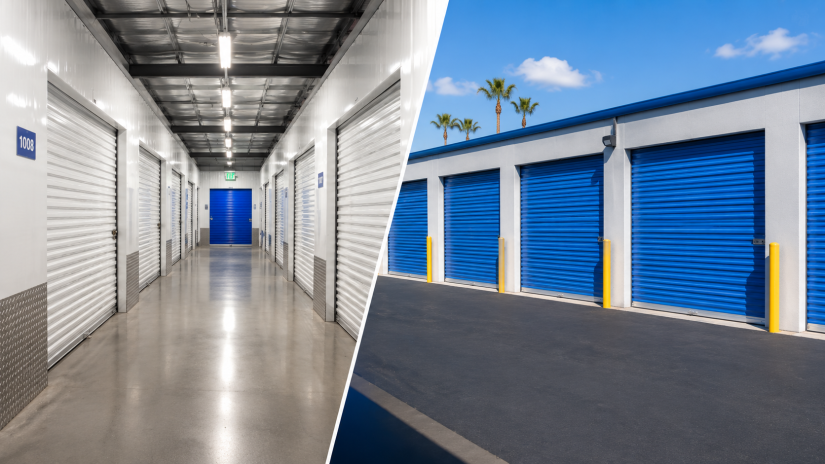


Indoor vs Drive-Up Storage: Which Type of Storage Unit Is Right for You?
Most people picking a storage unit for the first time focus on size. Access type, indoor or drive-up, is the decision that actually affects how usable the unit is day to day. Pick wrong and you're either hauling furniture through hallways every week or watching heat-sensitive items sit in a unit that hits 90 degrees in July.
What Indoor Storage Actually Means
Indoor units are inside a building. You pull into the parking lot, walk through the entrance, and find your unit down a hallway, sometimes after an elevator ride if it's on an upper floor. The door opens into that hallway, not outside.
The main advantage of being inside a building is environmental consistency. Indoor units are protected from direct sun exposure, rain, wind, and temperature swings that affect exterior units. At facilities that offer climate control, meaning active temperature and humidity regulation, that protection goes further. Climate controlled units stay within a set temperature range year-round, which matters for certain items and doesn't matter at all for others.
The trade-off is access. Getting large or heavy items in and out of an indoor unit requires more effort. You're working with a cart, an elevator if the unit isn't on the ground floor, and a hallway that may or may not be wide enough for whatever you're moving. For items you're storing long-term and rarely touching, that's a minor inconvenience. For items you're accessing every week, it adds up.
What Drive-Up Storage Actually Means
Drive-up units face the outside. The door rolls up, your vehicle backs in close, and you load or unload directly, no cart, no elevator, and no hallway to navigate with a couch.
If you have ever moved furniture through a multi-story building, you already understand why drive-up access is faster. A contractor stopping by every morning to grab tools, a business owner restocking inventory mid-week, that time difference adds up over a year-long lease.
Drive-up units are not climate controlled at most facilities. The inside of the unit reflects outdoor conditions, warmer in summer, cooler in winter, and affected by humidity. For most items, that's not a problem. For some, it is.
What Stores Well in an Indoor Unit
Indoor storage makes sense when what you are storing is sensitive to heat, humidity, or dust, or when the items are going in for the long haul and you will rarely need to touch them.
Wood Furniture
Wood moves. Solid wood expands and contracts as temperature and humidity shift, and prolonged exposure to heat or moisture causes warping, cracking, and joint failure. A climate controlled indoor unit holds those conditions steady.
Upholstered Furniture
Upholstered pieces have the same problem. Fabric and foam in a damp environment can develop mold or mildew over time.
Electronics
Electronics are another category where indoor storage makes sense. Heat accelerates the degradation of batteries, circuit boards, and screens. A climate controlled indoor unit keeps electronics in better shape during extended storage than a drive-up unit that heats up in summer.
Sensitive and Valuable Items
Documents, photographs, artwork, musical instruments, wine, and clothing that needs to stay in good condition all benefit from the regulated environment of an indoor unit. These aren't items you're likely pulling out weekly. They're going in and staying until you need them, which makes the access trade-off less relevant.
What Stores Well in a Drive-Up Unit
Drive-up storage works well for anything durable, anything large, and anything you're accessing often. The access model is built around making each trip fast and easy, which rewards renters who are in and out regularly.
Tools and Equipment
Tools and equipment are a natural fit. Contractors, landscapers, tradespeople, and hobbyists who need to grab gear and go benefit from pulling directly to the door. Power tools, hand tools, ladders, construction materials, none of these are heat-sensitive, and all of them are easier to load and unload from a drive-up unit.
Furniture During a Move
Furniture from a move is another common use. If you're between homes, staging items during a renovation, or clearing out a garage, the goal is usually to get things in fast and get them out when you're ready. Drive-up access makes both of those trips faster.
Most household furniture, sofas, bed frames, dressers, and appliances, handles standard temperature variation without issue.
Recreational and Seasonal Items
Vehicles, trailers, outdoor equipment, sporting goods, bikes, kayaks, camping gear, and seasonal items all fall into the drive-up category. These things live outside under normal circumstances and do fine in the same conditions inside a storage unit.
Business Inventory
Business inventory is where drive-up storage has become a practical alternative to commercial warehouse space for a lot of small operators. Regular deliveries and pickups are manageable when you're not navigating a building each time. For e-commerce sellers, contractors, and small retailers, a drive-up unit functions as an accessible off-site storeroom.
The Climate Control Question
Climate control is a feature of some indoor units, not all of them. Standard indoor units offer the protection of being inside a building without actively regulating temperature and humidity. Climate controlled units go further, maintaining a consistent environment year-round.
Whether climate control is worth the additional cost depends on what's being stored. For furniture, electronics, documents, instruments, and wine, yes. For tools, equipment, boxes of books, or everyday household items, probably not. The gap in price between a standard indoor unit and a climate controlled one is real, and paying for it when the items don't need it is unnecessary.
In Southern California specifically, the outdoor climate is relatively mild compared to regions with extreme winters or high humidity. Drive-up units in San Diego County, the Inland Empire, and surrounding areas hold up well for most storage purposes year-round. The summer heat in inland areas is the main factor worth thinking through. For truly heat-sensitive items, that matters. For most things, it doesn't.
How to Decide
Three questions cover most situations.
How Often Will You Access the Unit?
Daily, weekly, monthly, or rarely?
What Are You Storing?
How sensitive are the items to temperature and humidity?
What Size Do You Need?
Drive-up units at most facilities skew toward larger sizes.
If you're accessing the unit more than once a month and storing items that aren't temperature-sensitive, drive-up is almost always the more practical choice. If you're storing items long-term and they're sensitive to heat or humidity, indoor, and possibly climate controlled, is worth the access trade-off.
A lot of renters end up using both. A drive-up unit for the bulky, durable, high-access items and a smaller indoor unit for anything that needs more protection. It's not a common setup, but it's worth knowing it's an option if the mix of what you're storing doesn't fit neatly into one category.
StaxUP Storage Unit Options
StaxUP Storage has locations across Southern California offering both indoor and drive-up storage in a range of sizes. Some locations are exclusively drive-up, like the Bradley Ave facility in El Cajon, while others offer a mix. Outdoor parking spaces for vehicles are available at select locations, including Woodside Ave in Lakeside. Current availability by unit type and size can be checked at each location's page online.


